Liquid handling machines are robotics that can automate pipetting work in a wet lab. Though robotics can be efficient, many misunderstand the capabilities and the value of liquid handling machines. This article will explain what a liquid handling machine is, the misconceptions people have, and what value it brings, so that you can be more informed about liquid handling machines.
What is a liquid handling machine?
A liquid handling robot is a workbench with robotic arms that automate wet-lab workflows by running pre-configured scripts.
Workbench
A workbench is a place where labware and devices are placed. The devices mounted onto a workbench define the workflows the machine can enable. Large devices that cannot fit onto a worktable may sometimes be placed around the workbench, accessed using robotic arms. Below is a list of labware and devices that liquid handling machines may handle.
- SBS titer plates (96 well plate, etc.)
- deep well plates
- tubes supported by tube racks
- troughs that store reagents
- pipette tip boxes
- heater/ cooler
- shaker
- thermal cycler
- magnetic station
- plate storage station
- barcode reader
- spectrophotometer
- centrifuge
- freezer/ refrigerator storage
- HEPA filter
- weight scale
- colony picker
Robotic arm
A typical liquid handler can come with three arm types: 8-channel pipetting arm, 96/384-channel pipetting arm, and a robotic gripper arm. Up to three arms are usually chosen based on needs. Some robots have multiple of the same arm.
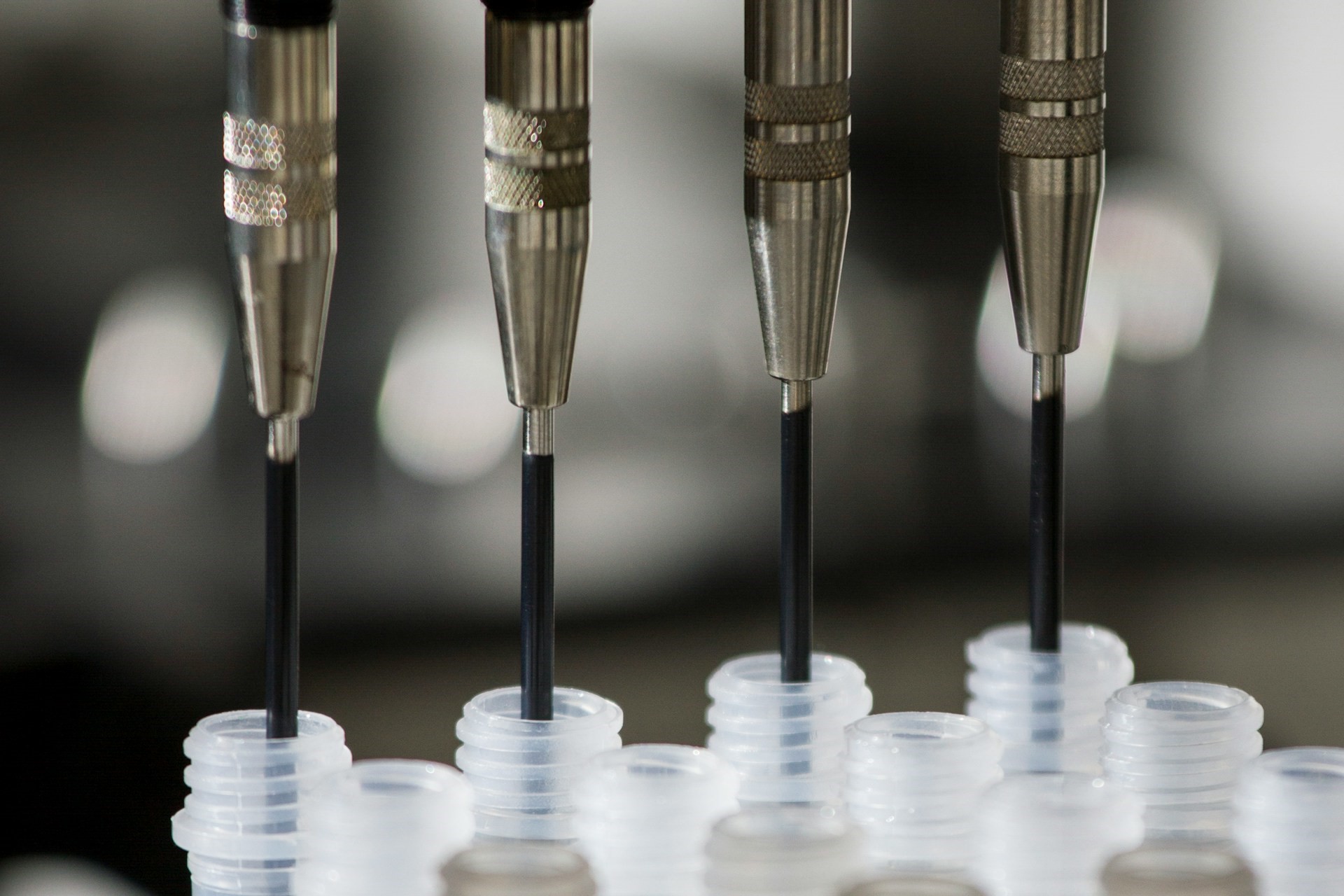
8-channel pipetting arm is the most popular arm due to its flexibility. Many manufacturers offer arms where each channel can move up and down and aspirate/dispense independently. The channels can also be spread out, meaning they can handle both a standard 96-well plate and a sparse tube rack.
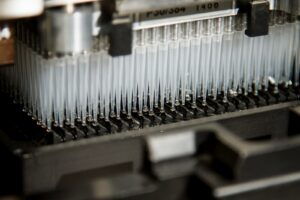
96/384-channel pipetting arm is capable of dispensing liquid into 96/384 tips simultaneously with a single pipetting motion. A key benefit is its ability to dispense reagents without time delays, which is crucial for spectrophotometric experiments. Other benefits include improved volume consistency and reduced turnaround time.
Robotic gripper arm enables complex workflows by moving labware between different locations. For example, the arm can move a plate from the worktable to a device and then to a storage. It can also dispose of waste in a bin to make room for more labware, effectively increasing throughput per run.
The script
Liquid handlers operate based on preconfigured scripts. Typically, engineers from robotics maker will write the script for the workflow that the lab managers want to automate. The software allows for flexible workflows by accommodating if-else statements and variable inputs.
For example, a script can allow users to input the dispensing volume for each well and the number of plates to process before the run. The robot can then inform the operator of the total reagent volume needed and where to place labwares. Once the run begins, the software may automatically utilize backup storage positions if the primary positions on the worktable are filled to capacity.
Misconceptions about liquid handling machines
The most common misconceptions people have about liquid handling machines are around its end-to-end automation capability, its speed, and its flexibility.
People often want to automate a workflow from end to end, but there is a trade-off between the length of the automated workflow and the size and cost of the liquid handling machine. A long, complex workflow simply requires more space for things, especially tip boxes. Smaller machines require more manual interventions to divide a long workflow into several steps, so that filled positions can be freed and necessary labware can be replenished.
Many expect the robot to work faster than a human. However, the speed of the robot is actually on par with an experienced human operator. The 8-channel arm and the gripper arm still need to perform the same tasks as a human, thus taking a similar amount of time. Though a liquid handler is uniquely capable of dispensing with a 96/384-channel arm, the 96/384-channel arm is usually used less frequently compared to other arms.
Lastly, a robot by its nature is not as flexible as a human. A robotic arm can move in x, y, and z directions. However, it does not have the flexibility to perform twisting and twirling movements. For example, if a workflow requires a pipette to be held in a slanted position, it might not be able to do it. The liquid handler arm is not as flexible as the human arm, but clever designs and workarounds may solve the issue. If your workflow involves a special pipetting maneuver, an engineer may be able to help you through a consultation.
The values of liquid handling machines
The values of liquid handling machines can be boiled down to consistency, reduced human management, and scalability.
Human operators may vary in performance from person to person and from day to day, but robotic performance is consistent and reproducible, leading to more reliable experimental outcomes.
Manual workflows require trained operators, and workflow performance can be affected by differences in operator experience, availability, and turnover. Implementing robotics will bring in new tasks like robotic handling training and periodic maintenance, but these tasks are generally easier to manage.
Lastly, because liquid handling machines are consistent from machine to machine and incur less management burden, they allow for easier throughput expansion with an additional machine purchase.
Conclusion
Here, I have outlined what a liquid handling robotic is, addressed some common misunderstandings about them, and explained the benefits they bring. Liquid handling machines are robots that automate wet-lab workflows through the use of their workbench space, arms, and scripts. While they may not always provide faster turnaround times or the same flexibility as a human, they deliver consistent results, reduce the human management burden, and provide scalability. I hope you find the information helpful.